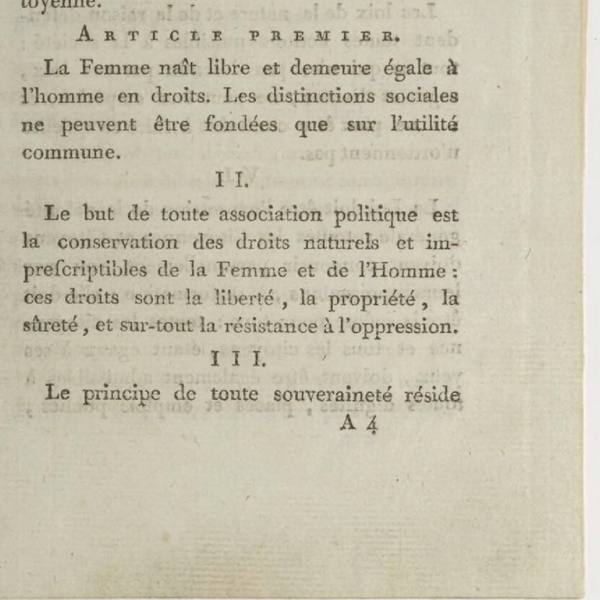
People in France still read a text by Olympe de Gouges. Back in 1791, she was a writer in Paris.
In 1789, France had a famous text about rights. It says men are born free and equal in rights. But what about women?
So her text is a copy, but with "woman" in it. Her first line: "Woman is born free." That doesn't mean women and men are the same. They just have the same rights.
But French women only had the vote from 1944. Today, people read the two lines side by side. One new word, and half of France is in the sentence.
Every Journeva story exists at four levels — same plot, same characters, richer language each step. Here is how this one begins at each level.
B1 · IntermediateIn September 1791, Olympe de Gouges, a Paris playwright, answered the Revolution's most famous text. …
B2 · Upper intermediateIn September 1791, Olympe de Gouges, a playwright from Montauban living in Paris, answered the Revolution's most famous text. …
Read the whole story at A2, B1 and B2
In the app you can tap any word for its meaning, listen to the story read aloud with the words lighting up, and save words to practise later. Ten stories are free at every level, and every story is free at A1.
Get Journeva on the App Store
Read it in a language you already know to check your understanding — every Journeva story is written in all five.
 Journeva